This page was translated automatically. The German original is binding. Read the German original

Helping others makes you happy!
Dear friends and supporters,
A newsletter was almost ready to be sent out in March when the coronavirus became a pressing issue. We hesitated to send it. But now we know there is a ‘new normal’; life goes on – differently, in some ways more demanding, but in many ways also at a slower pace and therefore more pleasant. We take each day as it comes with gratitude, do our best and continue to experience deeply moving things almost every day.
The coronavirus situation has required us to make a few adjustments, yet we are still very happy and grateful that we are able to continue our work as far as possible.
In mid-March, we suspended our outreach programmes to protect our team. It was with a heavy heart, as our homeless people and those living in the bush are very dear to us, but we must nevertheless try to protect our team. A few weeks later, the government here also imposed curfews, so we would have had to stop anyway, at least temporarily.
Our dentist is working on a limited basis for emergencies and matters that cannot wait. The GPs are working in the two mobile clinics up on the large football pitch in front of the village, so that here at the hospital we are ‘now only’ dealing with everything to do with pregnancy and children.
In the maternity ward, we’ve seen a significant rise in the number of pregnant women, as jobs are being lost in the city and people are returning to the countryside as a result. What’s more, there’s no longer any transport available, so even people who would normally have given birth further afield are now coming to us. And finally, there are so many Covid cases in Tana that pregnant women from all over, out of concern, are also preferring to come to us.
We hope you are all well and wish you an enjoyable read! Please continue to join us as we change the face of the world here in and around Ambovo, step by step, family by family.


The premature babies at MHM since June 2020
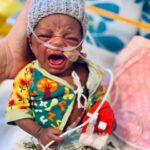
Over the last 7 weeks, alongside the many other babies, 10 premature babies have been born here – and we’ve had, and still have, our hands full. There were three sets of twins and four single babies. They were born between 13 and 5 weeks premature. We have never had so many very small babies requiring such a huge amount of extra care all at once.
Our team has learnt an enormous amount in the field of obstetrics and has developed very, very positively. The midwives have started training new midwives; the first of these are now on duty, having been trained by our local midwives and brought up to our standards. What a joy! This means I’m called to births less often, as both knowledge and practical skills continue to develop.
And then the premature babies arrived. A whole new world is opening up for us. We have a lot of equipment, such as heated cots, incubators, oxygen and CPAP machines. Much of this isn’t even available at the university children’s hospital. We have the staff and, thanks to you all, the financial means to care for such high-dependency patients. But we lack the knowledge and skills. At the start of the year, we had a volunteer from the neonatal intensive care unit in Aschaffenburg here with us, who trained our staff. Lots of theory, practical exercises, and now frequent remote help and support. And then we have another invaluable source of support, also from Aschaffenburg: Senior Consultant Dr Stuchlik, who supports us in caring for every unwell newborn and premature baby. That may sound crazy and unimaginable, but the situation here on the ground is so limited everywhere that it is the best thing that could ‘happen’ to our patients.


The current situation regarding the ten premature babies:
seven have already been discharged, and we see them regularly and continue to monitor them. The families often need a great deal of encouragement, support and information. And these babies have grown even closer to our hearts than all the others already have.
Our very tiny NyAvo has passed away – weighing just 900 gr and born 13 weeks premature, the chances of survival in Madagascar are, sadly, significantly lower than in a developed country.
And two are still with us: Fabiola and Toky. They need one or two people round the clock who do nothing but look after these two. Fabiola was the first baby we decided to deliver by caesarean section as a preterm baby – 9 weeks before her due date – because her mum’s very high blood pressure meant the blood supply was so poor that Fabiola wouldn’t have survived much longer in the womb.
Toky is his parents’ third child, and his siblings were also born here. Mum Tatamo is 20 years old, and her second child, Mihaja (2019), and now Toky were both born five weeks early.
And, of course, we also talk to the families about family planning and contraception – but the final decision rests with the parents! Every Monday, we provide free contraceptives – short-term, medium-term and long-term options. Yet the Madagascan ideal for a marriage – seven sons, seven daughters – is deeply ingrained in people’s minds.
We have now decided to write just one ‘story’ at a time, but to do so more frequently. My assistant, Rojo, will also take over from time to time when my time is needed more in the medical department. She is a very talented young woman who learnt German at the Goethe-Institut. She speaks and writes German – not perfectly yet, but very well – and is taking on more and more of my tasks relating to emails, reports and newsletters.
Thank you very much for your loyal support. Everyone can be part of the wonderful things we are able to do and experience here.
As always, we wish you all the very best and, above all, plenty of perseverance and strength during these challenging times.
In the picture below we see Sitraka – he was also born many weeks prematurely here in September 2019 and received long-term inpatient care. Today he is 11 months old, healthy and lively, and visits us regularly for check-ups, vaccinations, and whenever he is unwell.
It means a great deal to us as a team to maintain such a personal and close relationship with our patients. Sometimes it’s painful, but most of the time it’s a great joy!
Yours sincerely,
Tanja with Fanilo & Fifaliana, and on behalf of the whole team.


can change the face of the world. [African proverb]