This page was translated automatically. The German original is binding. Read the German original
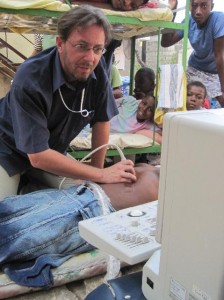
During the first two weeks of February 2010, our board member Dr. med. Dirk Englisch was in the earthquake-stricken area of Port-au-Prince (PaP) on official business and was also able to lend a hand at a newly built health centre in the city:
He carried out ultrasound scans on patients with unexplained abdominal symptoms in order to refer them for further effective treatment.
 Dr Englisch performing an ultrasound scan in Port-au-Prince
What had happened?
On 12 January 2010 at 16:53 local time, an earthquake measuring 7.0 on the Richter scale struck Haiti, in the western part of the Caribbean island of Hispaniola, with its epicentre near the village of Coupeau (25 km south-west of the capital, Port-au-Prince). Aftershocks are still being recorded today, with magnitudes of up to 6.2 measured at times. The regions of Ouest, Sud-Est and Nippes (Tiburon Peninsula) were the worst affected in Haiti.
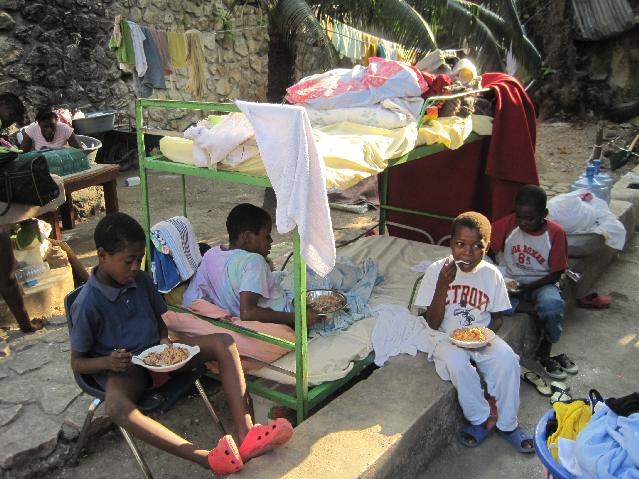
 People are living outdoors, away from their destroyed homes, partly out of fear of another tremor
The coastal town of Léogâne, with 80–90 per cent of its buildings destroyed, is the worst-affected town in the country. The earthquake was also felt in the Dominican Republic, but caused no major damage there. In PaP, with a population of 2 million across the entire metropolitan area, there was massive destruction.
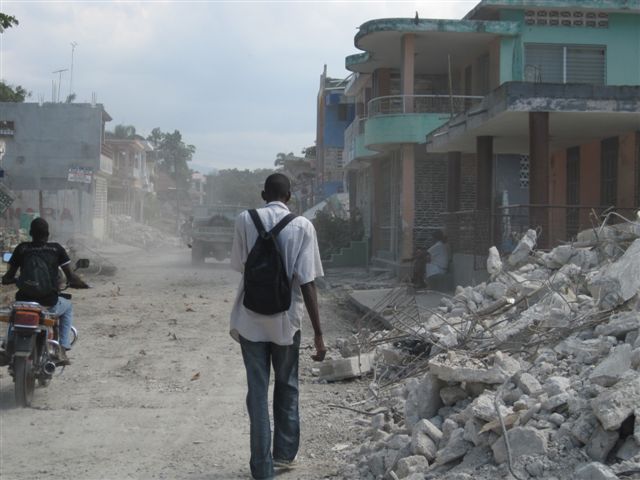 Leogane, almost completely destroyed
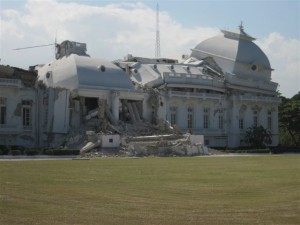 Presidential Palace
Most government ministries, the historic Presidential Palace built in 1912, the luxury Montuno Hotel, the headquarters of the UN peacekeeping forces (Christopher Hotel), almost all of the city’s hospitals and the Notre-Dame de L’Assomption Cathedral were largely destroyed.
Thousands of flats and private homes – some of which had been built in breach of building regulations – as well as numerous slum dwellings – particularly on hillsides – were also destroyed. The technical infrastructure, the electricity supply and, initially, the telephone and mobile phone networks were also largely rendered inoperable. Fortunately, large, explosive fuel depots at the harbour remained undamaged.
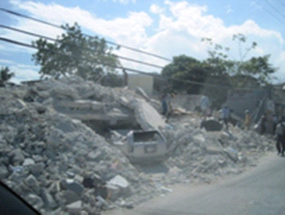 PaP city centre
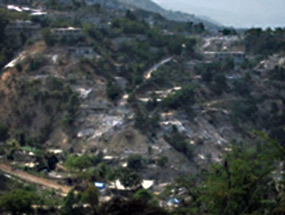 Destroyed hillside slum
The consequences of this disaster were a breakdown in public order in a country that was already politically unstable, inadequate first aid and rescue efforts, and a de facto collapse of private and state healthcare provision.
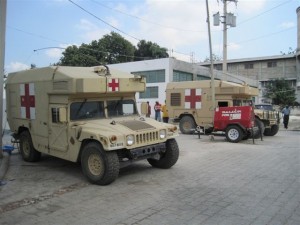 US field ambulance
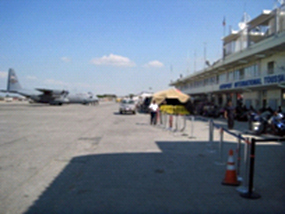 Port-au-Prince International Airport
Immediately after the earthquake, relief efforts for the affected population began. A ‘Joint Operations Task Centre’ (JOTC) is now coordinating international aid between the Haitian government, MINUSTAH, US and Canadian troops, and UN clusters/NGOs. 900 aid organisations are now active on the ground.
What is the situation like for the people there?
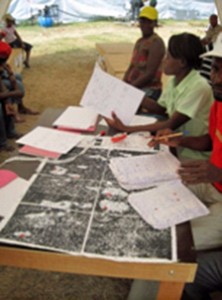
Due to political instability, corruption, nepotism and the shift in agriculture from meeting domestic needs to exports to the US and later to the NAFTA region, Haiti has become the poorest country in the Western Hemisphere:
The annual per capita income in 2007 was approximately US$600. Around 80 per cent of Haitians have to live on less than US$2 a day. This naturally also has negative consequences for the health sector.
Registration of patients with diarrhoea
According to the latest government estimates, a total of around 3 million people have been directly affected by the consequences of the earthquake. At least 230,000 people lost their lives, 300,000 were injured and over 1 million were left homeless. 1,234 schools were completely destroyed.
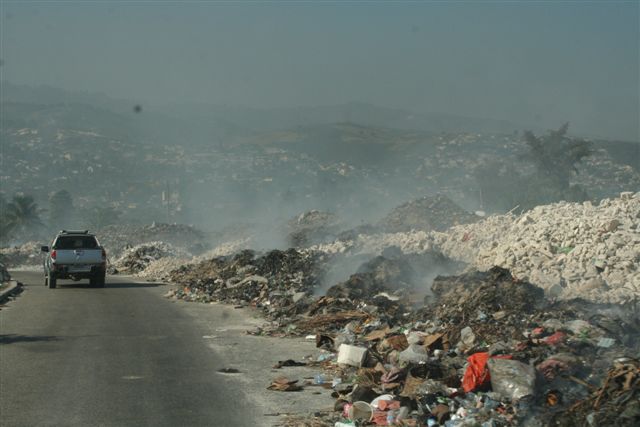 Rubbish and rubble dumps in PaP
20 million m³ of rubble must be cleared in PaP alone, for which 35,000 people have been employed (under ‘cash for work’ programmes). With food prices continuing to rise nationwide, 1 million Haitians have already been provided with food by the World Food Programme (WFP/PAM), and 338,000 people have received special two-week rations. A further 5,000 people still need to be provided with suitable accommodation, and water and hygiene are now increasingly becoming priority areas for aid.
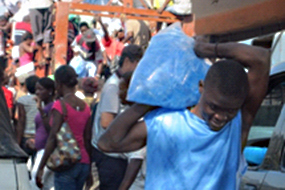 Distribution of drinking water in PaP
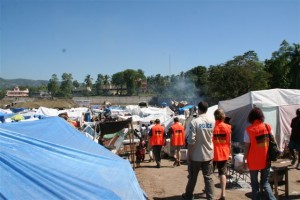 Refugee camp in Jacmel (approx. 3,500 people)
One shortcoming is the inadequate registration of IDPs. This makes it difficult to obtain reliable data on economic and health needs.
As, in addition to people being housed in tent camps, a large proportion of the population is moving around PaP and large parts of the country, options for providing them with support through mobile clinics and mobile kitchens are now being considered. In addition, UNICEF has so far distributed 171 so-called Child Protection Kits (clothing, bedding, food) to a total of 3,362 children.
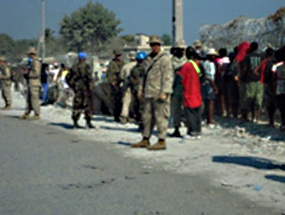 WFP food distribution under US and
Sri Lankan military protection
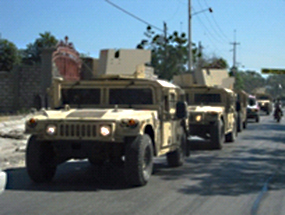 US military on the outskirts of
Port-au-Prince
The security situation – traditionally extremely critical in Haiti anyway – remains calm but tense. Staff losses within the police force have been replaced by colleagues previously suspended on disciplinary grounds, and approximately 5,000 prisoners have managed to escape from the destroyed prisons, of whom only 50 have so far been recaptured. Despite increased police patrols, gang fights and attacks, car thefts, robberies (‘shop-raiding’), and even rapes in refugee camps are therefore continuing to rise.
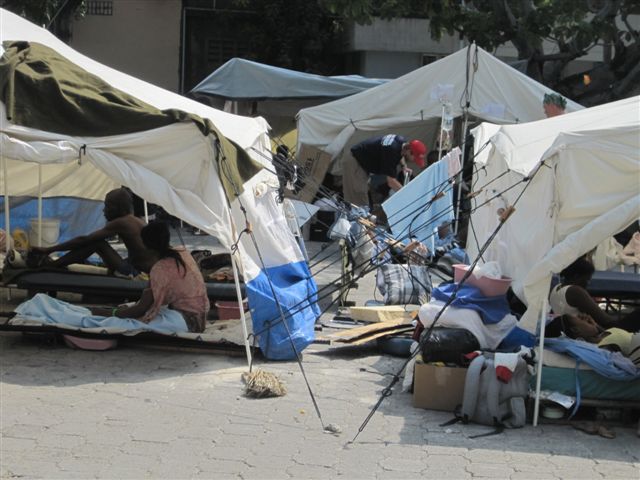 Patients in the courtyard of a destroyed hospital
In the health sector, the acute emergency phase is now over and we are in the post-emergency phase. This is evident from the fact that the number of trauma cases in hospitals is falling significantly and we are now seeing more and more patients with chronic general conditions – particularly those requiring surgery – as well as poorly cared-for amputation stumps, infected surgical wounds, necrotic skin areas under circular plaster casts, etc. According to estimates by Handicap International, 2,000–4,000 amputees in PaP alone are awaiting rehabilitation. As expected, the number of cases of diarrhoea, meningitis and acute respiratory infections (ARI) continues to rise. The number of tetanus cases is also continuing to increase. A vaccination campaign has therefore been launched in the meantime.
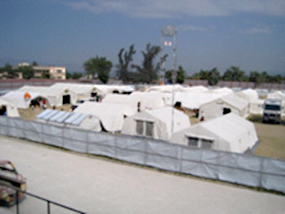 German Red Cross field hospital
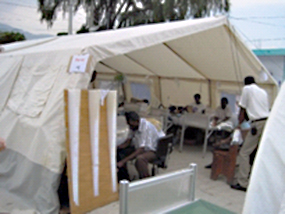 Medical tent
International organisations remain on the ground and are active in various areas of emergency relief. It will take years before the damage in Haiti has even begun to be repaired and a reasonably normal life is possible again. Tulisa is pleased to have played a small part in this through direct medical assistance.